

Whisky Congeners Explained: The Science of Flavour & Hangovers (2026)
Sip & Learn: Volume 165
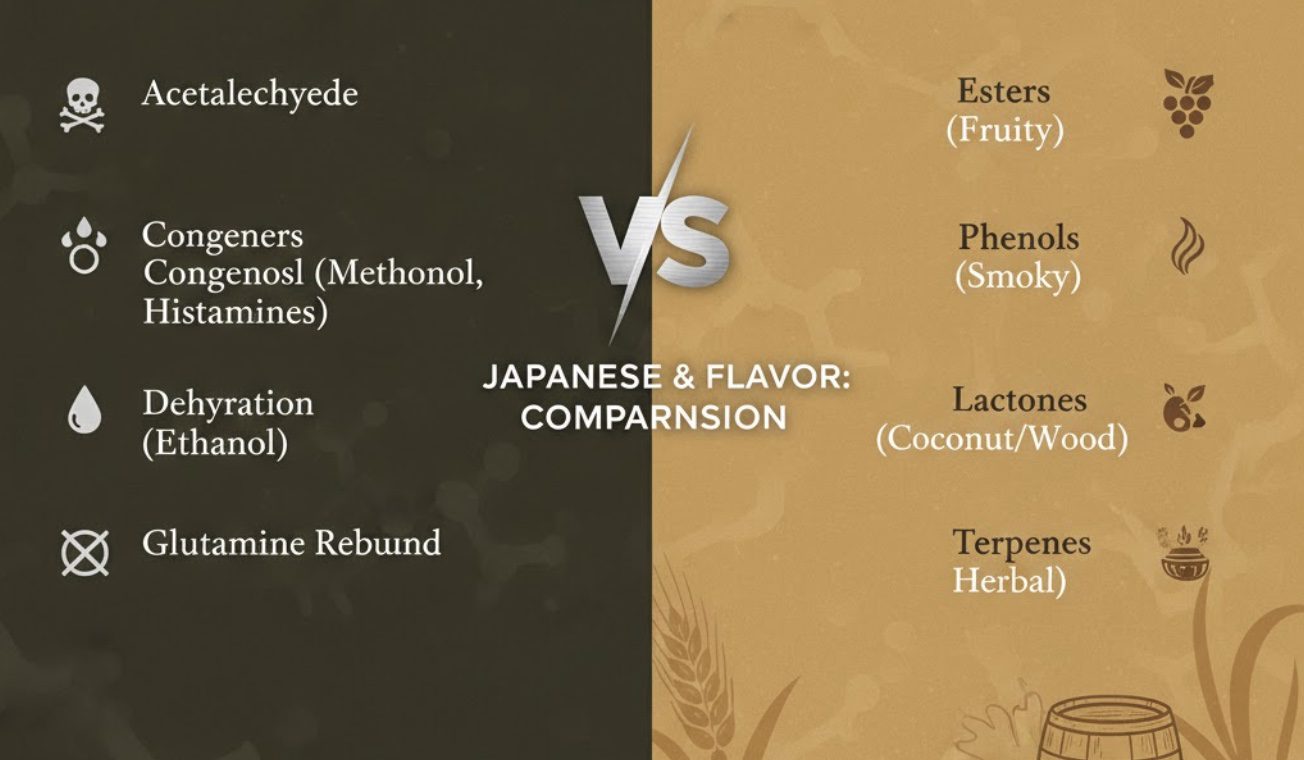
Have you ever wondered why a clear vodka leaves you feeling relatively fine the next morning, but a rich, heavy Bourbon leaves you with a pounding headache? The answer lies in **Whisky Congeners**.
These microscopic chemical compounds are a double-edged sword. On one hand, they are responsible for almost all the delicious aromas—vanilla, leather, fruit, and spice—that make whisky worth drinking.
On the other hand, they are notoriously difficult for your liver to process.
In this guide, we break down the science behind **Whisky Congeners**, why darker spirits contain more of them, and how to manage the morning after.
Table of Contents
Click below to jump to a section:
1. What Are Whisky Congeners?
When yeast ferments sugar into alcohol (ethanol), it doesn’t just create one type of alcohol. It creates a “chemical soup” of by-products. These biologically active compounds are called Congeners.
Common types include acetone, tannins, esters, aldehydes, and fusel oils. While ethanol gets you drunk, **Whisky Congeners** give the drink its soul. Without them, whisky would essentially be vodka—flavourless and neutral.
Curious about fermentation?
Learn how yeast creates flavour in Vol 30.
2. The Flavour vs. Hangover Trade-off
Here is the cruel irony of the spirit world: the better it tastes, the worse you might feel.
Your body treats Congeners as toxins. While your liver is busy processing the ethanol, these complex molecules linger in your bloodstream, triggering immune responses and inflammation. This is why “dark drinks” (like Bourbon, Red Wine, and Brandy) are scientifically proven to cause more severe hangovers than “clear drinks” (like Gin and Vodka).
A study by Brown University found that Bourbon had 37 times more congeners than Vodka.
Bourbon basics?
Read our definitive guide to American Whiskey (Vol 05).
3. High vs. Low Congener Spirits
Not all whiskies are created equal. The level of **Whisky Congeners** depends heavily on how the spirit was distilled.
The Congener Spectrum
- Pot Still Whisky (High Congeners)
Single Malt Scotch and Irish Pot Still Whiskey are distilled in copper pot stills. This method is inefficient on purpose—it retains heavy oils and esters to create a thick, oily mouthfeel. - Column Still Whisky (Lower Congeners)
Grain whiskies and some lighter Bourbons are distilled in tall column stills. This strips out more impurities, resulting in a lighter, “cleaner” spirit that might be kinder the next morning.
4. The Role of Filtration
Can you remove **Whisky Congeners**? Yes, through filtration.
This is exactly why Jack Daniel’s uses the “Lincoln County Process” (charcoal mellowing) and why many commercial whiskies are Chill-Filtered. By running the spirit through charcoal or chilling it to remove fatty acids, producers strip out some of the heavier congeners.
However, purists argue that by removing the congeners to “smooth” the drink, you are also stripping away the texture and complexity.
What is Chill Filtration?
See why connoisseurs hate filtered whisky (Vol 110).
Summary: Drink Darker, Drink Slower
**Whisky Congeners** are the price we pay for flavour. They turn a simple alcoholic liquid into a masterpiece of ageing and chemistry.
The takeaway is simple: Darker spirits are richer in flavour but harder on the body. Respect the chemistry, drink water, and savour the complexity slowly.
Become a Certified Expert
Take your knowledge from “hobbyist” to “connoisseur.” Join our Virtual Whiskey Tasting VIP program and get guided lessons, rare bottle alerts, and tasting notes sent straight to your inbox.