

The Spirit Safe: Why Distillers Lock the Alcohol (The Glass Box)
Sip & Learn: Volume 134
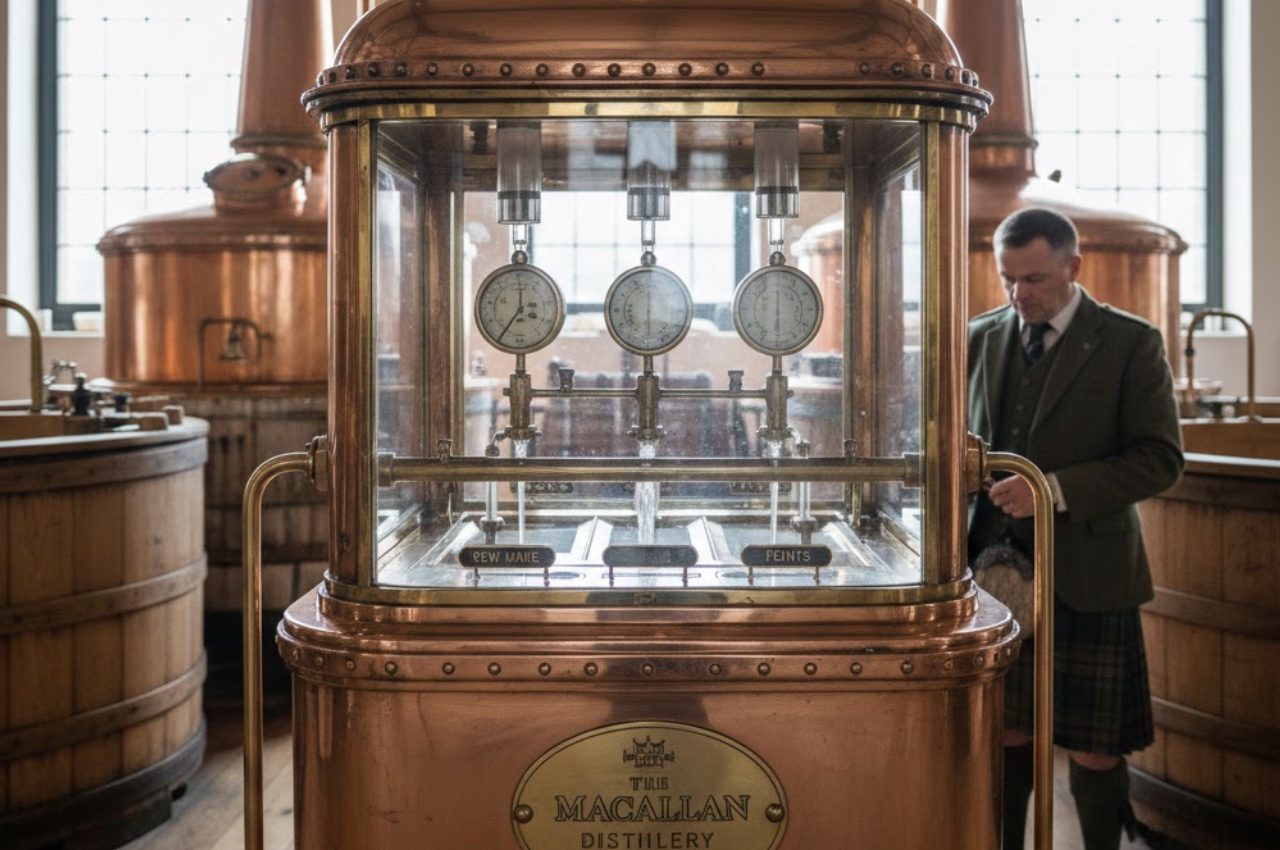
If you visit any traditional Scotch whisky distillery, the tour usually ends in the still house. There, amidst the massive copper pot stills, sits a strange, beautiful object.
It looks like an aquarium made of brass and glass. Inside, clear liquid rushes through spouts and bowls. And on the front, there is a large, heavy padlock.
This is the Spirit Safe.
For nearly 200 years, it was illegal to distill whisky without one. It is the physical manifestation of the battle between the distiller (who wants to make flavor) and the government (who wants to collect taxes).
But how does a distiller make whisky if they can’t touch, smell, or taste the spirit as it flows?
In this guide, we are going to unlock the secrets of the Spirit Safe whisky process and explain how the most important decision in distilling—”The Cut”—is made behind glass.
Table of Contents
Click below to jump to a section:
1. What is a Spirit Safe?
A Spirit Safe is a sealed metal and glass cabinet attached to the end of the condenser.
When the alcohol vapor turns back into liquid in the condenser, it flows directly into this box. From the box, it is directed into holding tanks.
Crucially, there is no way to access the liquid while it is inside the safe. The glass allows the Stillman to see the flow, but the brass frame is padlocked shut.
It was invented in the 1820s by Septimus Fox to solve a major problem: theft. Before the safe, workers (or owners) could easily siphon off high-proof spirit before it was measured for taxation. The safe ensured that every drop distilled was accounted for.
2. The Exciseman and The Key
For over 150 years, the Distillery Manager did not have the key to his own production line.
The key was held by the Exciseman (the tax officer from Her Majesty’s Customs and Excise).
The Exciseman would visit the distillery, unlock the safe to take samples or check measurements, and then lock it back up. If a pipe leaked or a valve broke inside the safe, the production had to stop until the government official arrived to open the door.
This relationship defined the Scotch industry. The Spirit Safe whisky production method meant that the government was essentially a partner in every distillery.
3. Making “The Cut” (Heads, Hearts, Tails)
The primary job of the Spirit Safe is to allow the Stillman to separate the good alcohol from the bad alcohol. This is called “Making the Cut.”
Distillation produces three fractions:
- Foreshots (Heads): The first liquid to flow. It is high in methanol and volatile compounds. It smells like nail polish remover and is toxic. This is diverted away.
- Middle Cut (Hearts): The sweet spot. This is pure ethanol with fruity esters. This is the only part that becomes whisky.
- Feints (Tails): The end of the run. It is low in alcohol but high in heavy, oily, sulfurous compounds. It smells like wet dog or burnt rubber. This is diverted away.
The Stillman must divert the flow from the “Foreshots” receiver to the “Spirit” receiver, and then to the “Feints” receiver, at exactly the right moments.
What creates those fruit flavors?
Read our guide to Esters (Vol 127).
4. How It Works (Remote Control)
Since the box is locked, the Stillman cannot smell or taste the liquid to know when to make the cut. They have to rely on instruments inside the box, manipulated by handles on the outside.
The Tools Inside:
- Hydrometer: A glass float that measures the density (ABV) of the spirit. The Stillman watches the float drop. When the ABV hits roughly 75%, they might switch to Hearts. When it drops to 60%, they might switch to Tails.
- Demisting Test: This is the visual trick. The Stillman uses a handle to mix the spirit with water in a glass bowl inside the safe. If the mixture turns cloudy (blue haze), it means there are still too many oils (Heads). When it stays clear, it is ready for the Heart cut.
It is a process of visual analysis and checking the numbers, rather than sensory tasting.
5. Is It Still Required Today?
In 1983, the UK laws changed. The physical presence of the Exciseman was no longer required at all times.
Today, most distilleries hold their own keys to the safe. However, the system of measurement is still strictly audited.
In many modern super-distilleries (like Macallan or Roseisle), the brass safe has been replaced (or supplemented) by digital flow meters and automatic valves controlled by a computer. The computer measures the density and makes the cut automatically.
However, almost all traditional distilleries keep the brass safe. It serves as a visual check for the operator and remains the romantic heart of the stillroom.
Pro Tip:
If you visit a distillery, ask the guide if their safe is “manual” or “computerized.” A manual safe requires a highly skilled artisan to watch the glass for hours. A computerized safe is efficient but lacks romance.
Where does the spirit go next?
Follow the journey to the Cooperage (Vol 130).
Summary: Art Meets Bureaucracy
The Spirit Safe is a unique invention. It is perhaps the only tool in the world designed simultaneously to facilitate art (making whisky) and enforce tax law.
Next time you sip a dram, think of the Stillman standing in front of that brass box, watching the demisting bowl, waiting for the exact second to turn the handle and capture the heart of the spirit.
Become a Certified Expert
Take your knowledge from “hobbyist” to “connoisseur.” Join our Virtual Whiskey Tasting VIP program and get guided lessons, rare bottle alerts, and tasting notes sent straight to your inbox.