

The Spirit Safe: Why Distillers Lock the Alcohol (2026 Guide)
Sip & Learn: Volume 67
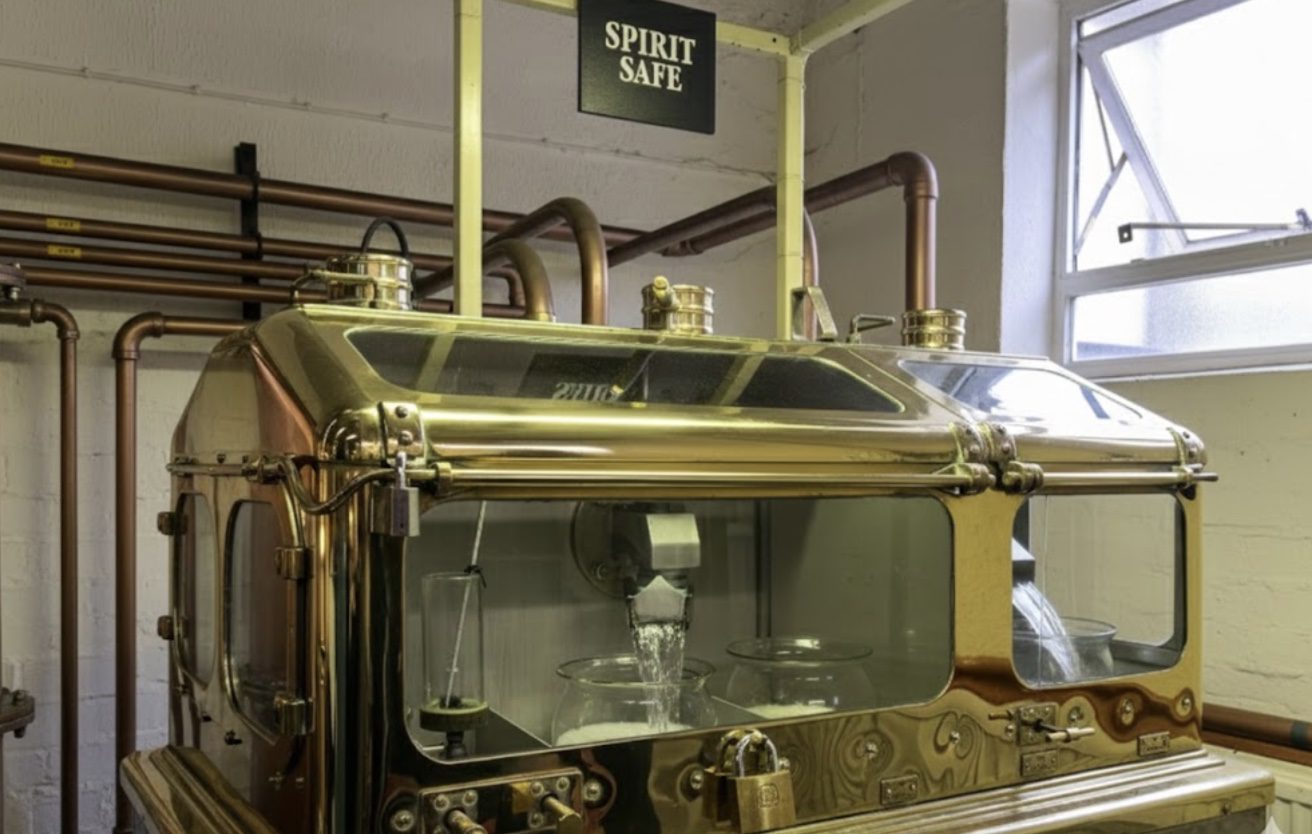
If you visit any traditional distillery in Scotland, the tour will eventually stop in front of a beautiful, polished brass and glass box.
Inside, clear liquid flows like a waterfall. Outside, there is a heavy, solid padlock.
This is the Whisky Spirit Safe.
It is the most important piece of equipment in the room. It is the checkpoint where beer becomes whisky.
But why is it locked?
For nearly 200 years, the distillery manager did not have the key to this box. The only person allowed to open it was a government tax collector known as the “Exciseman.”
In this guide, we are going to explore the history, the mechanics, and the legal reasons behind the Whisky Spirit Safe.
Table of Contents
Click below to jump to a section:
1. What is a Spirit Safe?
The Whisky Spirit Safe is a sealed glass and metal cabinet that houses the final output pipes of the Pot Stills.
When the spirit boils off the still and condenses back into liquid, it flows directly into this box.
The box has a series of levers and handles on the outside. These levers control valves on the inside.
The Function:
It allows the Stillman to see the spirit, measure its strength, and direct the flow into different tanks (Heads, Hearts, or Tails) without ever physically touching the liquid.
What are Heads and Tails?
Read our guide on the Art of Distillation Cuts here.
2. The Excise Act of 1823
Why go to all this trouble? Why not just pour it into a bucket?
Tax Evasion.
In the 1700s and early 1800s, illicit distilling was rampant in Scotland. Farmers would distill whisky at night and smuggle it south to avoid paying taxes to the British crown.
In 1823, the Excise Act was passed. It legalized distillation for a fee, but it came with strict rules. The government wanted to measure every single drop of alcohol produced so they could tax it.
The Whisky Spirit Safe was invented (and patented by James Fox in 1825) to ensure that the distiller could not siphon off any “untaxed” spirit before it was measured.
The Padlock Rule:
For over 150 years, the safe was padlocked by Customs & Excise. The distiller did not have a key. If they wanted to open the safe to clean it or fix a leak, they had to call the government official to come and unlock it.
3. How it Works: Analyzing without Touching
Imagine trying to drive a car from the back seat using strings attached to the steering wheel. That is what operating a Whisky Spirit Safe is like.
The Stillman needs to know the Alcohol by Volume (ABV) of the liquid flowing through the pipes to know when to make the “Cut.”
But he can’t touch the liquid. So, how does he measure it?
The Hydrometer Jar
Inside the safe, there are glass jars containing floating instruments called Hydrometers.
The Stillman pulls a lever on the outside. This diverts the flow of spirit into the jar. As the jar fills up, the hydrometer floats.
- If the spirit is strong (high alcohol), the hydrometer sinks lower.
- If the spirit is weak (more water), the hydrometer floats higher.
By looking through the glass window and reading the scale on the floating hydrometer, the Stillman knows the exact strength of the spirit without opening the box.
What happens to the liquid next?
It goes into the barrel. Read about maturation here.
4. The “Demisting Test” (Quality Control)
The Whisky Spirit Safe isn’t just for tax; it is for quality.
As the distillation reaches the end (The Tails), heavy oils begin to come over the still. These oils smell like wet cardboard and cheese. You do not want them in your barrel.
These oils are soluble in high-strength alcohol, so the spirit looks clear even when the oils are present.
The Water Trick:
The Stillman uses a lever to mix a small amount of water with the spirit inside a special mixing bowl within the safe.
When water is added, the ABV drops. At lower strength, the heavy oils are no longer soluble. They turn the liquid Cloudy.
If the sample goes cloudy, the Stillman knows the “Tails” have arrived. He immediately pulls the handle to divert the flow away from the spirit receiver.
5. Do They Still Use Keys Today?
The laws changed significantly in 1983.
Her Majesty’s Customs and Excise decided that they no longer needed to physically lock the box. Modern flow meters and digital sensors could track the alcohol production more accurately than a padlock.
Today, the distillery manager does have the key.
However, almost every distillery in Scotland still uses the brass Whisky Spirit Safe. Why?
- Tradition: It is the heart of the still room.
- Visual Check: Computers can measure flow, but they cannot see clarity. The human eye is still the best tool for judging the “Demisting Test.”
- Manual Control: Craft distillers prefer to make the “Cut” by hand, trusting their instinct over a computer algorithm.
Want to visit a distillery?
Check out our guide to the Whisky Regions of Scotland.
6. Summary: The Symbol of Scotch
The Whisky Spirit Safe is a reminder of a time when whisky was an outlaw industry.
It represents the tension between the artist (the distiller) and the government (the taxman).
Even though the padlocks are no longer sealed by the government, the ritual remains. Every drop of Scotch in your glass passed through one of these brass boxes under the watchful eye of a Stillman.
Become a Certified Expert
Take your knowledge from “hobbyist” to “connoisseur.” Join our Virtual Whiskey Tasting VIP program and get guided lessons, rare bottle alerts, and tasting notes sent straight to your inbox.