

Ice Sphere vs Ice Cube: Which Melts Slower? (The Science of Dilution)
Sip & Learn: Volume 125
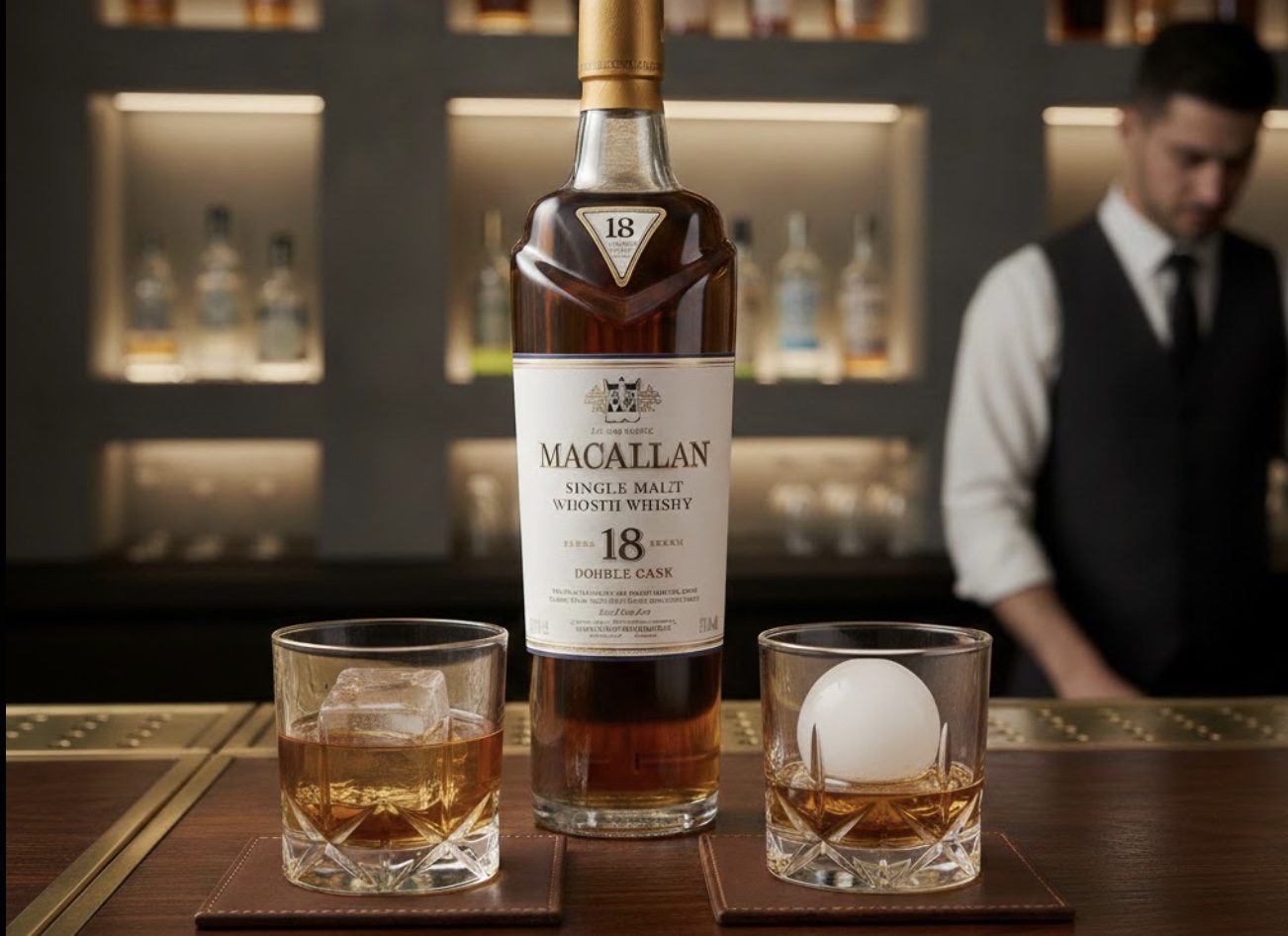
Walk into any high-end cocktail bar in Tokyo, London, or New York, and order a whisky on the rocks. You won’t get a glass filled with cloudy, jagged chips from a soda machine.
Instead, you will likely be presented with a single, massive, crystal-clear sphere of ice.
It looks beautiful, certainly. It catches the light and makes the drink look expensive. But is there a functional reason for the shape? Or is it just theater?
The debate of Ice Sphere vs Cube is actually a debate about physics and geometry.
The shape of your ice determines how fast it melts, and therefore, how quickly your premium single malt turns into watery disappointment.
In this guide, we are going to break down the science of surface area, explain why corners are the enemy of flavor, and help you decide which mold belongs in your freezer.
Table of Contents
Click below to jump to a section:
1. The Geometry: Surface Area to Volume
The science behind the Ice Sphere vs Ice Cube debate comes down to one simple ratio: Surface Area vs. Volume.
The Goal: You want maximum volume (mass) to cool the drink, but minimum surface area touching the liquid.
Why? Because ice melts where it touches the warmer liquid. Less contact means slower melting.
The Math:
A sphere has the lowest possible surface area for any given volume. Mathematically, a 2-inch ice sphere has significantly less surface area exposed to the whiskey than a 2-inch ice cube.
This means the sphere can chill the drink just as effectively as the cube (because of its mass) but will take much longer to melt into water.
2. Why Corners are the Enemy
Watch a square ice cube melt. Where does it disappear first? The corners.
A standard cube has 8 corners and 12 edges. These sharp points are attacked by the warm liquid from three sides at once. They melt almost instantly, shedding water into your dram before the core of the ice has even started to work.
A sphere has no corners and no edges. The liquid flows smoothly around it.
This allows for a uniform, slow reduction in size. While a cube will eventually become a rounded lump after 15 minutes, the sphere starts that way, saving you from that initial burst of unwanted dilution.
Worried about watering down your dram?
Learn about ABV and Proof in our Glossary (Vol 110).
3. The Taste Test: Dilution Control
Is dilution always bad? No.
A small amount of water opens up the bouquet of a whisky, releasing esters and aromas. However, there is a fine line between “opening up” a drink and “killing” it.
Small Standard Cubes:
These offer rapid cooling but rapid dilution. Within 10 minutes, your 46% ABV scotch might taste like 20% ABV flavored water.
Large Sphere:
This offers slow cooling and slow dilution. You can nurse a drink for 45 minutes, and the last sip will taste almost as potent as the first. This is crucial for expensive or Cask Strength whiskies.
4. Molds vs. Ice Presses
So, how do you get them?
Silicone Molds ($15 – $30):
The most affordable option. You fill a two-part silicone ball with water and freeze it.
Pros: Cheap.
Cons: Often creates a visible seam; difficult to get perfectly clear ice without “directional freezing” techniques.
Aluminum/Copper Ice Press ($150 – $1000):
This is what high-end bars use. You place a large jagged block of clear ice between two heavy metal halves. The thermal conductivity of the metal melts the ice into a perfect sphere in seconds.
Pros: Perfect geometry, zero seams, fun to watch.
Cons: Expensive and heavy.
5. Clear Ice Matters More Than Shape
Here is the secret pro tip: A cloudy sphere will melt faster than a clear cube.
Why is ice cloudy?
Cloudiness is caused by trapped air bubbles and impurities pushed to the center as the water freezes from the outside in. These air bubbles make the ice less dense (porous).
Clear Ice:
Clear ice is solid water with no air pockets. It is much denser. Because it is denser, it melts significantly slower.
If you have to choose between a cloudy sphere and a clear large cube, choose the clear cube. Clarity wins over geometry every time. But a clear sphere? That is the holy grail.
Pro Tip:
To make clear ice at home, use the “Directional Freezing” method. Put water in a small cooler (igloo) inside your freezer, leaving the lid off. The ice will freeze from the top down, pushing air bubbles to the bottom.
Pairing your chilled whisky?
Check out our Whisky and Steak Pairing Guide (Vol 123).
Summary: The Verdict
In the battle of Ice Sphere vs Cube, the Sphere is the undisputed champion of slow dilution.
- Everyday Drinking: A large (2-inch) square cube is perfectly fine and easier to store.
- Special Occasions: A clear ice sphere offers the best thermal performance and the best presentation.
Whichever you choose, just promise us one thing: stop using the tiny ice chips from your refrigerator door. Your whisky deserves better.
Become a Certified Expert
Take your knowledge from “hobbyist” to “connoisseur.” Join our Virtual Whiskey Tasting VIP program and get guided lessons, rare bottle alerts, and tasting notes sent straight to your inbox.