

Malt vs Grain Whisky: 4 Critical Differences That Change Everything
Sip & Learn: Volume 144
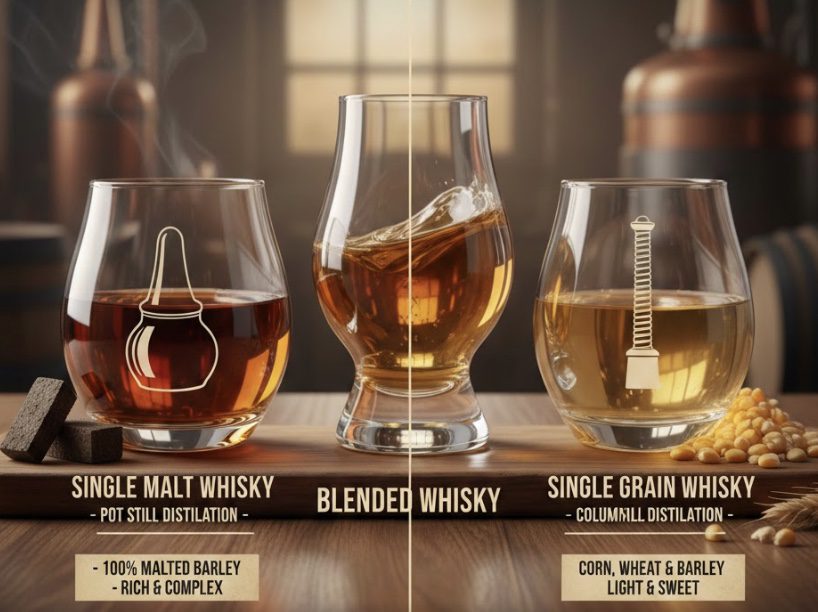
Walk down the whisky aisle, and you will see “Single Malt” printed on the most expensive bottles. On the cheaper bottles, you might see “Blended Scotch Whisky.”
The difference between these two categories isn’t just marketing hype; it comes down to the fundamental biology of the ingredients.
The battle of Malt vs Grain Whisky is a battle between tradition and efficiency. It is the difference between a pot still and a column still, between barley and corn, and between heavy texture and light sweetness.
To truly understand what is in your glass, you must understand the raw materials. Why is barley “malted”? Why is grain whisky considered “lighter”?
In this guide, we are going to break down the science of the seeds and how they dictate the final flavor of your dram.
Table of Contents
Click below to jump to a section:
1. The Ingredient: Barley vs. The Rest
The first major difference in Malt vs Grain Whisky is the seed itself.
Malt Whisky:
By law in Scotland, Single Malt must be made from 100% Malted Barley. Barley is a difficult grain. It has a tough husk and needs to be “tricked” into releasing its sugar. This process is called “Malting”—soaking the grain in water until it sprouts, then drying it (sometimes with peat smoke). This creates a nutty, biscuity, and cereal-rich flavor base.
Grain Whisky:
Grain Whisky is not picky. It can be made from Wheat or Corn (with a small percentage of malted barley added to help fermentation). Wheat creates a soft, bready spirit. Corn (used in Bourbon and many Scotch blends) creates a sweet, creamy, buttery spirit.
2. The Process: Pot vs. Column Still
The ingredients dictate the machinery.
Malt Whisky (The Pot Still):
Malted barley wash is distilled in Copper Pot Stills. This is a “Batch Process” (like making a pot of soup). It is inefficient and slow. However, it retains a massive amount of flavor, oil, and texture from the grain. The copper contact is crucial for removing sulfur.
Grain Whisky (The Column Still):
Grain whisky is distilled in huge industrial Column Stills (Coffey Stills). This is a “Continuous Process” (like a factory line). It is incredibly efficient and can produce alcohol up to 94% ABV. Because it is distilled to such a high strength, it strips out many of the heavy oils, resulting in a lighter, cleaner spirit.
How do stills affect flavor?
Read about Pot Stills and Condensers (Vol 113).
3. Flavor Profile Comparison
If you poured a glass of new-make Malt spirit next to a glass of new-make Grain spirit, the difference would be obvious.
Malt Whisky Profile
- Texture: Heavy, oily, viscous.
- Flavor: Cereal, toasted bread, nuts, earth.
- Complexity: High. It often carries “distillery character” (e.g., meatiness, sulfur, fruit).
Grain Whisky Profile
- Texture: Light, thin, crisp.
- Flavor: Vanilla, toffee, coconut, solvent/glue (when young).
- Complexity: Low initially. It relies heavily on the cask for flavor during aging.
4. The “Single Grain” Revolution
For decades, Grain Whisky was only used as “filler” to bulk up blends like Johnnie Walker.
However, when Grain Whisky is aged for a long time (20, 30, or 40 years), it transforms. The harsh solvent notes evaporate, and the interaction with the wood turns it into a creamy, vanilla-bomb masterpiece.
Bottles like The Girvan Patent Still or North British single grains are becoming cult favorites. They offer the complexity of an old whisky at a fraction of the price of an equivalent Single Malt.
The ultimate blend?
See how Malt and Grain work together in Blends (Vol 129).
5. Why is Malt More Expensive?
If you look at the shelf, Malt is almost always pricier. Why?
Yield: A ton of wheat produces more alcohol than a ton of barley.
Speed: A column still runs 24/7. A pot still has to be cleaned and reset after every batch.
Aging: Malt whisky generally needs less time to become “drinkable” (10-12 years), whereas Grain whisky often needs longer to smooth out its edges, but the sheer volume of production makes Grain cheaper to produce per liter.
Summary: You Need Both
The debate of Malt vs Grain Whisky shouldn’t be about which is “better.” They serve different purposes.
Malt provides the “Meat”—the heavy, complex character. Grain provides the “Canvas”—the sweet, light background that holds everything together.
Without Malt, whisky would be boring. Without Grain, Blended Scotch (the world’s most popular whisky) wouldn’t exist.
Become a Certified Expert
Take your knowledge from “hobbyist” to “connoisseur.” Join our Virtual Whiskey Tasting VIP program and get guided lessons, rare bottle alerts, and tasting notes sent straight to your inbox.