
The Peat Bogs of Islay: 10,000 Years of Flavor (2026 Guide)
Sip & Learn: Volume 77
The smell of Islay whisky is unmistakable. It smells of iodine, sea spray, tar, and bonfire ash.
To a beginner, it can be shocking. To a connoisseur, it is the smell of history.
The secret to this flavor lies beneath the ground. Islay Peat History is a story that goes back 10,000 years to the end of the last Ice Age.
While other regions in Scotland use peat, none of them taste like Islay. Why? Because the land itself is different.
In this guide, we are going to dig into the geology, the botany, and the chemistry of the peat bogs to understand why this small Hebridean island produces the most distinct spirit on earth.
Table of Contents
Click below to jump to a section:
1. What is Peat? (The Geological Sponge)
Peat is the first step in the formation of coal. It is organic matter (plants, moss, trees) that has died but has not fully decayed.
Normally, when a plant dies, oxygen allows bacteria to break it down into compost. However, Islay is wet. The ground is waterlogged.
The water prevents oxygen from reaching the dead plants. Instead of rotting away, the vegetation is compressed into a dense, carbon-rich mud.
The Timeline:
It takes 1,000 years to form just 1 meter (3 feet) of peat. When you drink a dram of Laphroaig, you are tasting vegetation that grew before the Pyramids of Giza were built.
How does the smoke get into the grain?
Read our step-by-step guide to the Malting Process here.
2. Islay Peat History: Marine vs. Terrestrial
Not all smoke tastes the same.
If you drink a Highland whisky like Highland Park (Orkney), the smoke tastes floral, like heather honey or a wood fire.
If you drink an Islay whisky like Ardbeg, the smoke tastes like iodine, salt, and seaweed.
The Reason: Vegetation.
Highland Peat (Terrestrial): Made from decomposed trees, heather, and bracken. It creates a “wood smoke” flavor.
Islay Peat (Marine): Islay has very few trees. It is constantly battered by Atlantic storms. The peat bogs are saturated with salt spray. The vegetation that decomposed there includes seaweed, algae, and sphagnum moss.
When you burn Islay peat, you are literally burning ancient seaweed. That is where the “Medicinal” note comes from.
Want to taste the difference?
Read our Peated vs Unpeated Whisky Guide.
3. The Cutting: A Dying Art
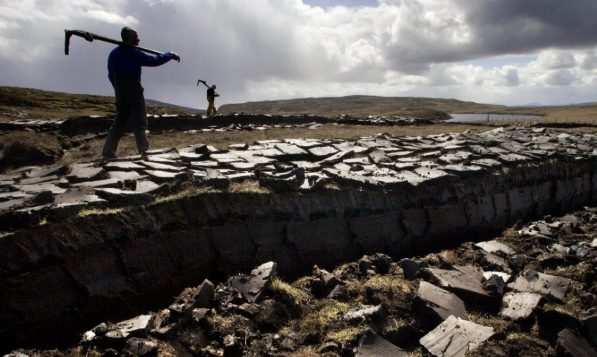
For centuries, cutting peat was a necessity for survival. It was the only fuel source for heating homes on the island.
In Islay Peat History, entire families would go out to the moss in May.
They use a specialized tool called a Torrisple (Peat Iron). It looks like a long spade with a right-angled blade.
The peat is cut into long, brick-like slabs. These wet slabs are stacked in pyramids to dry in the wind for weeks. They must be dry before they can burn.
Today, most peat is harvested by machine, but a few distilleries still hand-cut portions of their peat to preserve the tradition.
4. The Chemistry: Cresols vs. Guaiacols
When the dried peat is burned in the kiln to dry the malted barley, it releases chemical compounds known as Phenols.
These phenols stick to the barley husk.
However, the type of phenol varies:
- Guaiacol: Tastes smoky, sweet, and like toasted wood. Common in all peated whisky.
- Cresol: Tastes like tar, iodine, and disinfectant. This is unique to Islay Peat.
This is why Laphroaig is famous for its “Hospital Bandage” smell. It has the highest concentration of Cresols in the industry.
PPM Explained:
Phenols are measured in PPM (Parts Per Million). A light whisky might have 10 PPM. An Islay monster like Octomore can have over 100 PPM.
5. Port Ellen Maltings: The Engine Room
If you visit Islay, you will see a massive industrial building near the village of Port Ellen.
This is the Port Ellen Maltings.
Most Islay distilleries (Lagavulin, Caol Ila, Ardbeg) do not malt their own barley anymore. They buy it from Port Ellen.
Port Ellen Maltings digs the peat from the local Castlehill bog, burns it, and supplies the “Pre-Smoked” grain to the distilleries based on their specific recipes (e.g., “Give me 50 tons of 40 PPM malt”).
The Exception:
Distilleries like Laphroaig, Bowmore, and Kilchoman still have their own “Floor Maltings” where they do a portion of the work by hand. This gives them a unique flavor profile that is distinct from the Port Ellen standard.
Want to try these bottles?
Check out our list of the Best Smoky Whiskies for Beginners.
6. Summary: Tasting the Land
The story of Islay Peat History is the story of terroir.
When you drink a glass of Islay Single Malt, you are not just tasting alcohol. You are tasting the storms, the seaweed, and the moss of an island that has been accumulating flavor for 10,000 years.
It is a flavor that cannot be faked in a lab. It can only come from the ground.
Become a Certified Expert
Take your knowledge from “hobbyist” to “connoisseur.” Join our Virtual Whiskey Tasting VIP program and get guided lessons, rare bottle alerts, and tasting notes sent straight to your inbox.