

How to Use a Whisky Flavor Wheel: Decode Your Dram (2026)
Sip & Learn: Volume 63
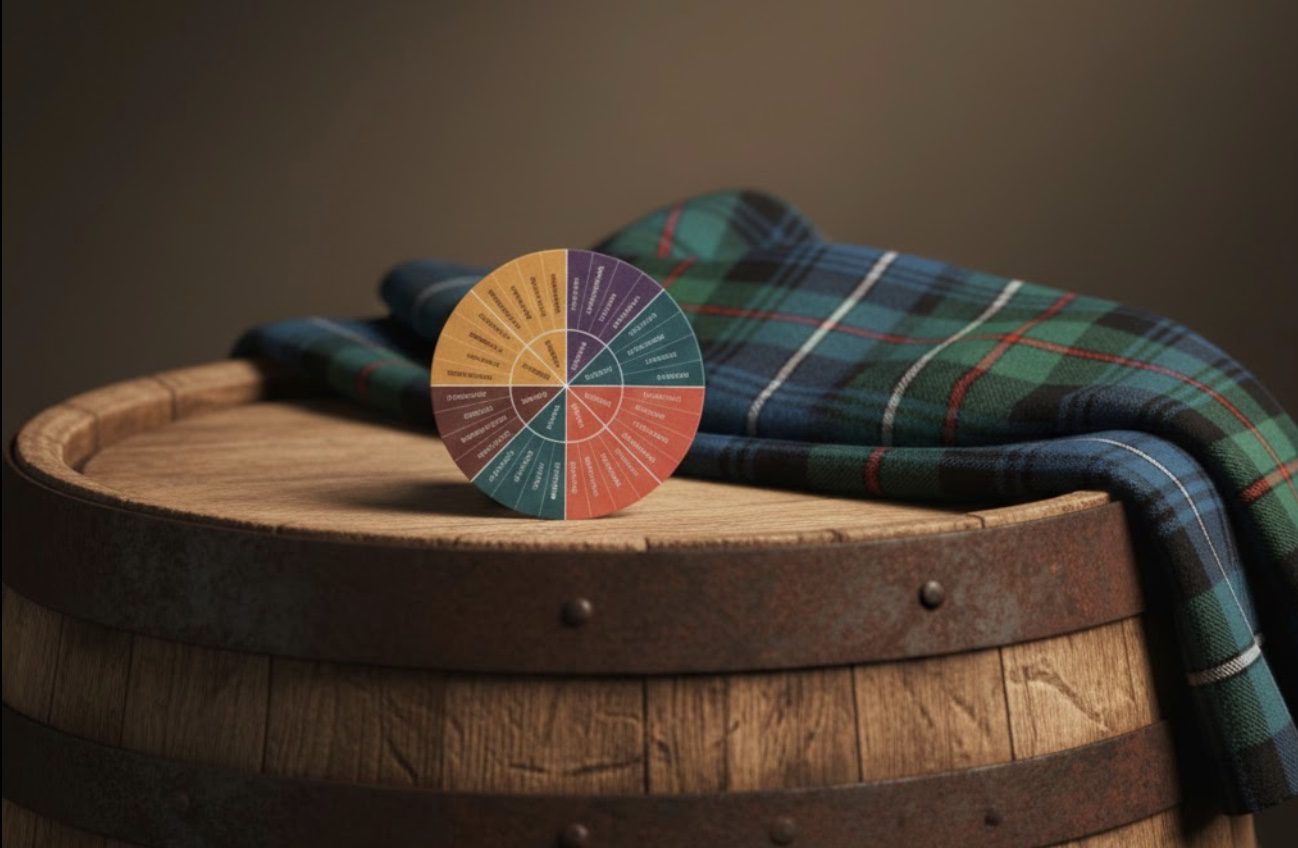
The biggest frustration for a whisky beginner is the “Tip of the Tongue” phenomenon.
You take a sip. You know it tastes familiar. It reminds you of a specific fruit, or a dessert, or a memory from your childhood. But you cannot find the word for it.
You say: “It tastes like… whisky.”
Meanwhile, a professional reviewer says: “It tastes like poached pears, manuka honey, and saddle leather.”
How do they do that? They use a tool called the Whisky Flavor Wheel.
In this guide, we are going to teach you how to use this visual map to unlock your palate, expand your vocabulary, and finally articulate exactly what is in your glass.
Table of Contents
Click below to jump to a section:
1. What is a Whisky Flavor Wheel?
The Whisky Flavor Wheel was originally developed in the 1970s by sensory scientists at the Scotch Whisky Research Institute (Pentlands).
It is a circular chart that organizes flavor descriptors into logical groups.
Think of it like a color wheel, but for your nose. Just as “Navy” and “Sky” are grouped under “Blue,” flavors like “Apple” and “Pear” are grouped under “Fruity.”
Why use it?
Our brains are wired to recognize smells, but we often lack the vocabulary to name them. The wheel provides the words. When you see the word “Vanilla” on the chart, your brain clicks and says, “Yes! That is what I am smelling!”
Before you start: You need to know how to nose the glass properly.
Read our 5-Step Tasting Method guide first.
2. The 8 Main Flavor Camps
Every Whisky Flavor Wheel is divided into broad sectors. To use it effectively, you need to understand the main “Camps.”
1. Cereal / Grainy
The foundation. Smells like porridge, husky malt, hay, or fresh bread. (Common in Lowland Scotch).
2. Fruity
Divided into Fresh Fruit (Apples/Pears) found in Speyside, and Dried Fruit (Raisins/Figs) found in Sherry Casks.
3. Floral
Light and fragrant. Notes of heather, cut grass, rose petals, or lavender. (Common in Japanese Whisky).
4. Peaty / Smoky
The intense sector. Smells like bonfire, iodine, tar, or smoked bacon. (Common in Islay Scotch).
The other sectors include Woody (Vanilla/Oak), Winey (Sherry/Nutty), Sulphury (Meaty/Rubber), and Feinty (Leather/Tobacco).
3. Step-by-Step: How to Use the Wheel
Do not try to find “Dried Turkish Apricot” immediately. You will get frustrated.
Use the “Inside-Out” Technique.
Step 1: Start at the Center
Take a sniff. Ask yourself the broad question: “Is this Sweet or Smoky?”
If it is Sweet, look at the “Sweet” side of the wheel.
Step 2: Move to the Middle Ring
Okay, it is sweet. Is it “Fruity Sweet” or “Woody Sweet”?
It smells like fruit. So you move to the “Fruity” slice.
Step 3: Move to the Outer Ring
Now you are in the detail zone. Is that fruit fresh (Apple) or dried (Raisin)? Or is it tropical (Banana)?
By narrowing it down step-by-step, you force your brain to categorize the smell logically.
Smelling smoke?
Check our Peated Whisky Guide to identify if it is “Bonfire” or “Medicinal.”
4. The Science: Where Do These Flavors Come From?
Using a Whisky Flavor Wheel helps you understand how the whisky was made.
1. Esters (Fruit)
If you smell pear drops, banana, or pineapple, you are smelling Esters. These are created during Fermentation. A long fermentation time creates more fruit.
2. Vanillin (Wood)
If you smell vanilla, coconut, or caramel, you are smelling Lignin. This comes from the American White Oak cask.
3. Phenols (Smoke)
If you smell smoke, tar, or ash, you are smelling Phenols. This comes from burning peat to dry the barley.
Want to understand the wood notes?
Read our guide on Sherry vs Bourbon Casks.
5. Building Your Personal Taste Profile
Once you master the Whisky Flavor Wheel, you can use it to buy better bottles.
If you analyze three of your favorite bottles and realize they all land in the “Dried Fruit / Spicy” sector, you know you love Sherry Cask Whisky.
If your favorites all land in the “Medicinal / Smoky” sector, you are an Islay fan.
Stop buying random bottles. Use the wheel to map your palate, and then buy bottles that fit your map.
6. Summary: Practice Makes Perfect
You don’t become a Master Blender overnight.
Print out a Whisky Flavor Wheel. Keep it next to your liquor cabinet. Every time you pour a dram, spend 30 seconds looking at the wheel.
You will be amazed at how quickly your brain learns to connect the dots. Suddenly, you aren’t just drinking whisky; you are understanding it.
Ready to start?
Pick up a few bottles using our Beginner’s Collection Guide.
Become a Certified Expert
Take your knowledge from “hobbyist” to “connoisseur.” Join our Virtual Whiskey Tasting VIP program and get guided lessons, rare bottle alerts, and tasting notes sent straight to your inbox.