
Four Roses Distillery Tour: The Most Romantic Stop on the Trail (2026 Guide)
Sip & Learn: Volume 85
If you drive along the Salt River in Lawrenceburg, Kentucky, you will see a building that looks out of place.
It doesn’t look like a gritty industrial factory. It doesn’t look like a rustic wooden barn. It looks like a Spanish Hacienda or a Californian winery.
This is the Four Roses Distillery, and it is widely considered the most beautiful stop on the Kentucky Bourbon Trail.
But Four Roses is not just a pretty face. Inside those yellow adobe walls lies one of the most complex and scientific production processes in the entire whiskey world.
While most distilleries use one recipe to make one bourbon, Four Roses uses ten different recipes to paint a masterpiece of flavor.
In this guide, we are going to take you on a detailed Four Roses Distillery tour, exploring the history, the architecture, and the science of the 10 recipes.
Table of Contents
Click below to jump to a section:
1. The Architecture: Why Spanish Mission Style?
When you arrive for your Four Roses Distillery tour, the first thing you notice is the architecture.
Built in 1910, the distillery features red tile roofs, yellow stucco walls, and arched windows. It is listed on the National Register of Historic Places.
Why this style?
At the time, “Spanish Mission” architecture was incredibly popular in California. The distillery owners wanted to signal that their bourbon was sophisticated and elegant, distancing themselves from the rough, “moonshine” image of Kentucky whiskey in the early 20th century.
It worked. Even today, walking through the courtyard feels more like visiting a vineyard in Napa Valley than a whiskey factory in Lawrenceburg.
Love bourbon history?
Read our guide on how Prohibition nearly destroyed this industry.
2. The Legend: A Proposal and a Corsage
The name “Four Roses” is steeped in romance.
According to legend, the founder, Paul Jones Jr., fell in love with a Southern belle. He proposed marriage to her via a letter.
She replied that if her answer was “Yes,” she would wear a corsage of four red roses to the upcoming grand ball. If the answer was “No,” she would wear nothing.
On the night of the ball, she arrived wearing a gown adorned with a corsage of four red roses.
Paul Jones Jr. later named his bourbon “Four Roses” to immortalize the moment she said yes. While historians debate the accuracy of this tale, it remains the heart of the brand’s identity and is featured prominently on every tour.
3. The Science: 2 Mash Bills x 5 Yeasts
This is where Four Roses separates itself from every other distillery.
Most distilleries use one recipe (Mash Bill) and one yeast strain. They make one liquid and age it for different amounts of time.
Four Roses creates 10 distinct recipes.
The Two Mash Bills
- Mash Bill B (High Rye): 60% Corn, 35% Rye, 5% Malted Barley. This creates a spicy, full-bodied spirit.
- Mash Bill E (Low Rye): 75% Corn, 20% Rye, 5% Malted Barley. This creates a sweet, creamy, corn-forward spirit.
The Five Yeast Strains
They ferment these two mash bills using five proprietary yeast strains, each creating a specific flavor code:
- K (Spice): Baking spices, nutmeg.
- Q (Floral): Rose petals, cherry.
- O (Fruit): Rich red berries, stone fruit.
- F (Herbal): Mint, tobacco, leather.
- V (Delicate Fruit): Light pear, apple, creamy.
The Alchemy:
By combining 2 Mash Bills with 5 Yeasts, they get 10 Recipes (e.g., OESV, OBSK). The standard “Four Roses Small Batch” blends four of these together to create a perfectly balanced profile. The “Single Barrel” bottles showcase just one recipe at a time.
Why does yeast matter?
Read our deep dive on Yeast & Fermentation science here.
4. Single Story Rickhouses: The Climate Control
Most Kentucky bourbon warehouses (rickhouses) are massive, towering structures that are 7 to 9 stories tall.
In a tall warehouse, the top floor is scorching hot (fast aging) and the bottom floor is cool (slow aging). This creates inconsistency. Distilleries have to rotate barrels to even out the flavor.
The Four Roses Difference:
Four Roses uses Single-Story Rickhouses located at their Cox’s Creek facility (about 45 minutes from the distillery).
Because the buildings are only one floor high, the temperature is consistent for every single barrel. There is no “top shelf” vs “bottom shelf” difference. This allows for a much more gentle, consistent maturation process.
This is why Four Roses bourbon is rarely “over-oaked” or bitter, even at older ages.
Understanding the difference?
Check out our Single Barrel vs Small Batch guide.
5. The Tasting Room Experience
The highlight of the Four Roses Distillery tour is the guided tasting.
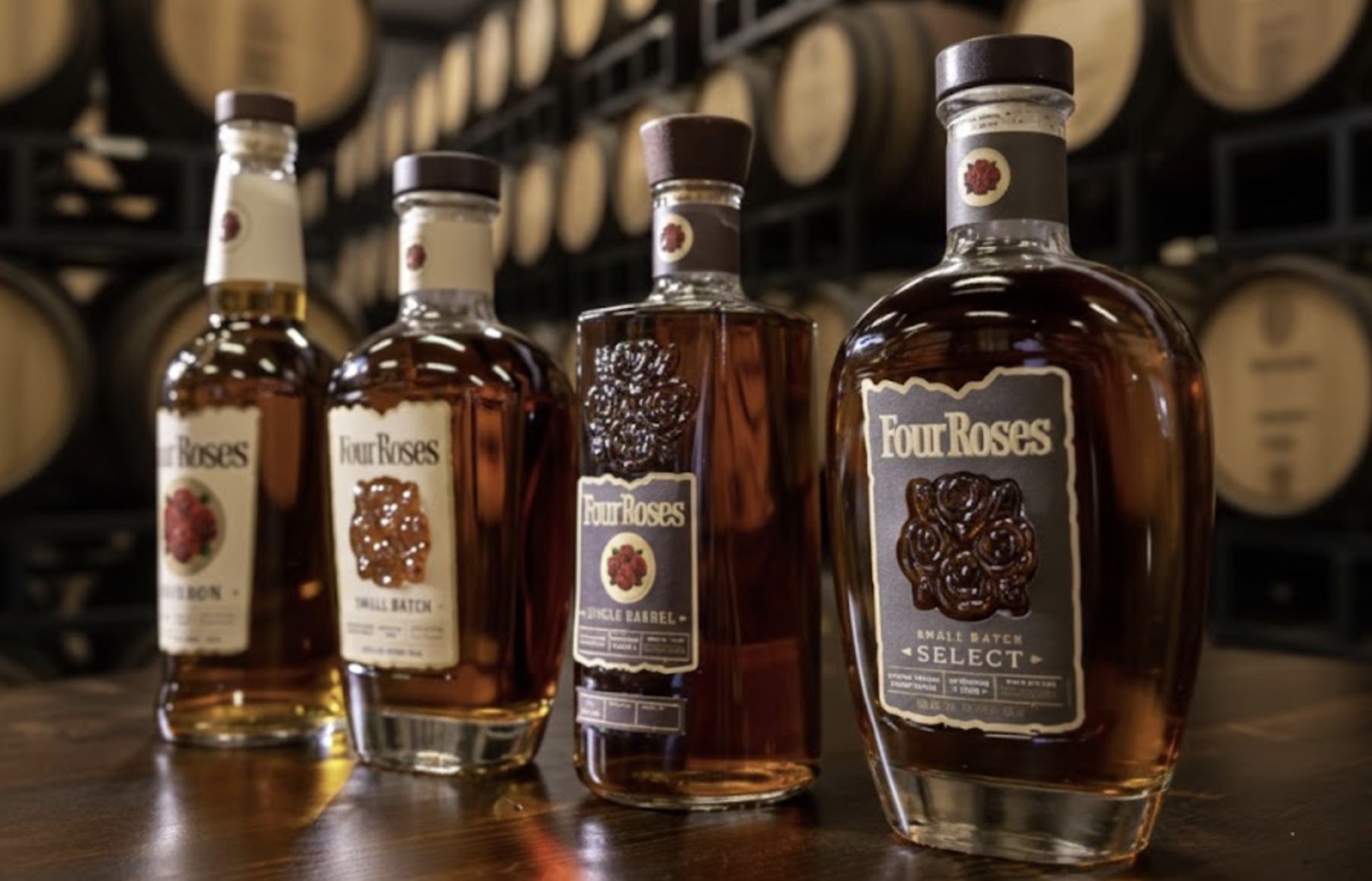
You sit in a modern tasting room overlooking the beautiful Spanish-style grounds. You will typically taste three expressions:
- Four Roses Bourbon (Yellow Label): The entry-level, mixing bourbon.
- Small Batch: The balanced blend of four recipes. Rich and creamy.
- Single Barrel: The high-rye (OBSV) powerhouse. 100 Proof. Spicy and complex.
The Gift Shop Secret:
Always check the gift shop for “Private Selection” bottles. These are Single Barrel bottles bottled at Cask Strength that feature one of the 10 specific recipes (e.g., OESK). These are rare, collectible, and often the best bourbon you will ever taste.
Looking for value?
See how Four Roses compares in our Best Bourbon Under $50 list.
6. Summary: Why You Must Visit
The Four Roses Distillery tour offers the perfect balance of history, romance, and hard science.
It is visually stunning, making it perfect for photos, but it is also intellectually satisfying for the true whiskey nerd who wants to understand yeast strains and mash bills.
If you only have time to visit one distillery in Lawrenceburg, make it this one.
Become a Certified Expert
Take your knowledge from “hobbyist” to “connoisseur.” Join our Virtual Whiskey Tasting VIP program and get guided lessons, rare bottle alerts, and tasting notes sent straight to your inbox.